Who's the George? (FIXED VERSION!)

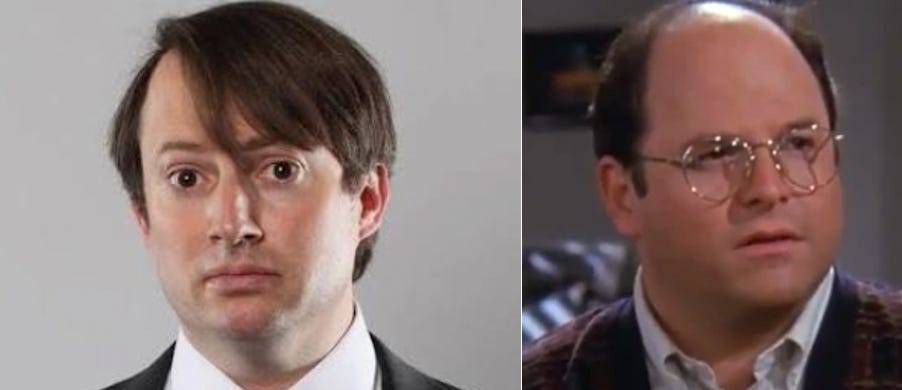
Liberated from the burden of demonstrating relevance (book’s been out over a month and is therefore in come-what-may territory on the publicity front) I can now return to the only topic that actually matters: a compare-contrast of the British and American comedy traditions. A challenge rendered somewhat more challenging by a sticky “o” key on my laptop. Cmedy traditins more like but I’m trying here.
I was thinking that Monty Python’s Life of Brian was derivative of History of the World, Part I, but then learned they were released in 1979 and 1981, respectively. This led me down a chronologies and grudges sinkhole to be explored more later. I’ve long said that Curb Your Enthusiasm is One Foot in the Grave but with rich Americans instead of working-class Brits, but because Curb is the one I encountered first, it will always feel to me like the influence went the opposite way it could have. Even though my hunch is that Larry David playing a version of himself owes nothing to Victor Meldrew.
In her great post about what “authenticity” means if you’re a Mark, Cartoons Hate Her calls Peep Show, “a lower-budget, drier British Seinfeld set in the 2000’s.” CHH introduced me to Peep Show, and it seems like we find it relatable in similar ways, as Marks. (If we were to meet in person, which of us would be the Mark? Would I just be the Gerrard?)
But it’s the Seinfeld comparisons I’ve been fixated on for some time now. I had called Mark “a gentile, gentle George Costanza, with a twist of Rebecca Bunch (Crazy Ex-Girlfriend)” but can’t decide how George he is or isn’t. Sometimes the show veers dangerously close to just presenting George Costanza with hair and an English accent. When Mark is down (unemployed, or doing something that outside of sitcom would render someone unemployable), he’s pure George. When he’s up—a good worker-bee, the portrait of conscientiousness—not so George at all. Mark has a touch of the George secret-horrible-thoughts, aided by the audible inner monologue gimmick. And a good number of these do center on thinking women very much in his league (as Mark-the-character) are below what he should be aiming for.
Is Jez therefore Jerry? Both are portrayed as having a magnetic effect on women. In Jerry’s case this is probably more accurate to how it would go for such a person (and has gone for the real-life person). In Jez’s it’s more like, a man with nothing going on but played by a very handsome and charming actor would pull like it’s nothing.
Both Jerry and Jez have effortlessness going for them. But because Seinfeld is an American show, Jerry’s allure has to be tied with competence and professional success. Instead of the mish-mash of winner-loser traits distributed to Jez and Mark, there’s Jerry-the-winner in contrast to George-the-loser. Confusingly, given that he is super chill and sleeps with a different woman every week, Jerry-the-character is an uptight clean freak germophobe goody-two-shoes. Is this because the Nice Jewish Boy is a trope, and Jerry is that thing?
Where does Jewish-gentile enter into it versus US-UK? Because it’s not as if Peep Show is a Jews-free zone, not hardly. At first I was having a feeling about how the actresses cast as ‘date where the man wishes he were with a different, hotter woman’ kept being short or part-Jewish women who looked a lot like me, sending my letter of complaint to the proverbial newspaper. But then Big Suze the hottie is played by a part-Jewish actress who reads as no less Jewy than the settled-fors. Then Mark’s dream girl comes along, a young Victoria-Wood-looking woman who is played by an actress Jewish enough to have been profiled for being quasi-Jewish in the Jewish Chronicle. It’s not for nothing Seinfeld and not Peep Show coined “shiksappeal.”
The US-UK divide seems more in the thing where not-working can be someone’s job (it is Kramer’s, but this is presented as odd and mysterious and not a government-benefits or secret-family-money thing).
But there have been these glimmers of a moment, watching Peep Show, when I thought, this is Seinfeld right? I don’t know enough about TV behind-the-scenes to know which budgets fall where, unless exciting special effects or celebrity cameos enter into it. But Peep Show is aesthetically in the realist realm of Girls more than the studio-audience, laugh-track, visually phoned-in world of Seinfeld. It’s not that Seinfeld looks polished and posh, it’s that it looks like a TV set from the 1990s. It’s light on details. Someone clearly spent a lot of time thinking about the sort of apartment Jez and Mark would live in, on getting that right. Jerry… has a blue couch and a bunch of cereal?
It’s Girls-like in the frank if not larger-than-typical presence of drugs. It’s recent-college-grad (they’re 27ish, I think, at the beginning?) middle-class pseudo-squalor. Arts-scene-adjacent, with spending money available and nowhere to be in the morning. It’s very unlike Girls in that I don’t recall a decade spent contemplating whether Jez has unchecked privilege, but this could be because he is, as I have mentioned, very pretty. Meanwhile on Seinfeld there is, like, the episode where Elaine has alcohol, and the one where Kramer does, or maybe that was the same episode but different scenes. It wouldn’t have even occurred to me that anyone smoked on the show were it not for the Netflix warnings about tobacco usage depicted, which seem to refer to Kramer’s cigars. Jerry himself is squeaky-clean, his consumption habits permanently those of a 6-year-old. Is this because the show was American network television of its vintage?
On Frasier, Frasier and Niles had a jug of sherry an evening but this was played as sophistication and it was still sherry and not DRUGS apart from the time when Niles thinks he’s eaten some pot brownies and acts ‘stoned’ which he is not, it was a normal brownie, it was in fact Martin the ex-cop dad who has inadvertently pot-brownie’d himself. Niles, so uptight, so uncool, but also so good-boy. But all of this brings up another important question:
Is Mark Corrigan Niles Crane?

I don't care how relevant it is I'd happily read an entire book on your views on Peep Show
I watched Peep Show recently; on your recommendation, in fact. I liked it a lot—it's right up there for me with Seinfeld and Fawlty Towers. It's been a while since I saw the show but I never thought of Jerry as having a magnetic effect on women or as dating a different woman every week/month. Since an episode in Seinfeld almost never continues on from the previous episode, I don't attach much significance to the new characters who appear—including new girlfriends. I simply see them as 'girlfriend-with-characteristic-X' serving such and such a function in that particular episode. With the exception of the episodes with Susan and Puddy, all four characters seem to see several new people and to date without much difficulty. Of course, they talk about how George finds it difficult to pull, but we see him with many, many women. Not that that ever felt like a contradiction. Since I never thought of the show as either continuous or somewhat realistic (in the ways that Peep Show is), I kind of went along with how the show views George and disregarded the many women he dates. By the same token, I never thought of Jerry as being irresistible to women, since that was not emphasized as a trope. Or do I misremember?
And yeah, I've always assumed the squeaky clean habits were a result of network television's restrictions. But I liked how the show functioned within (what I presumed to be) those limits, and was bored/disappointed by aspects of Curb, precisely because Larry David seemed to have been given free rein. (I've only watched a few Curb episodes though.)