Splatter

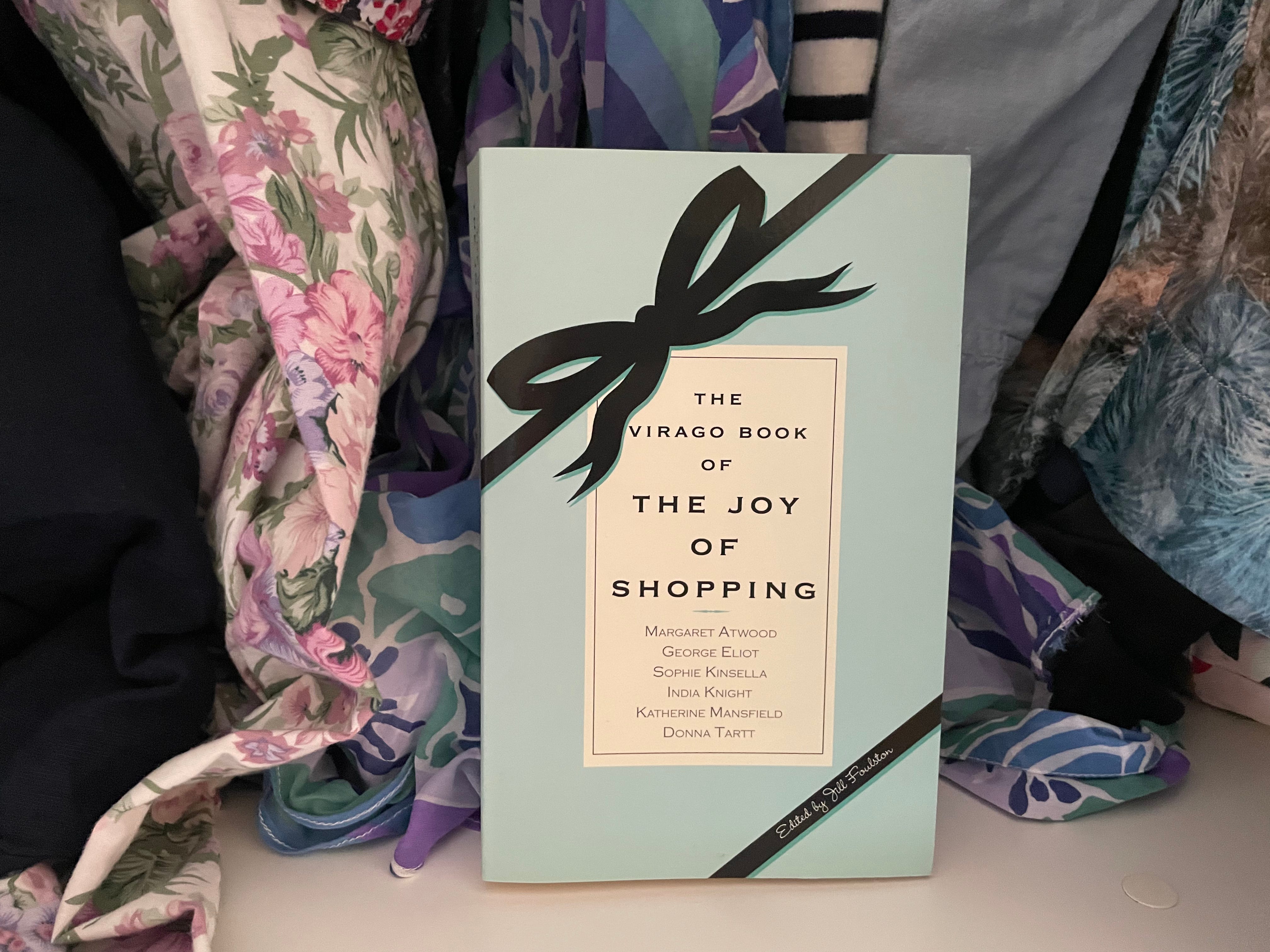
I know you’ve all been waiting to hear updates on my book-pub-date-induced midlife crisis slash no-clothes-shopping vow. Epiphanies, backslides, anything?
One bit of kismet was a Little Free Library find: The Joy of Shopping, a 2010 British quotation-and-short-passage compendium, more entertaining than that sounds, featuring none other than Margaret Atwood. I have so many questions, both about who’d have bought this book generally (for self/as gift?) and who, specifically, was getting rid of it in my neighborhood, now, and for what reason. Did Roncesvalles’ sole shopping-enjoyer just pass on? This is the only explanation that would make sense. The book’s contents, I have thoughts there as well, which I will otherwise save until finished reading.
One of the entries, not Atwood’s, prompted me to google what compulsive shopping is, to see if this applies.
Take it away, Wikipedia:
“Unlike normal consumers and hoarders, who derive excitement and focus on the items purchased, compulsive buyers gain excitement and focus on the acquisition process itself and not the item purchased.”
Given how interested I am in my own collection of mainly-vintage clothes, I am probably either a normal consumer or a hoarder; given that it is possible to walk through my home without tripping over Laura Ashley dresses, it is probably, boringly, the former.
But I might be a raging reformed clothes-shopping fiend yet! It seems like, as with anything, your behavior is a problem if you experience it as a problem behavior. Most surprising to me, and most concerning given my own inclinations, was that browsing itself can be pathological, regardless of whether you’re putting your household in the poorhouse: “Compulsive buying is not limited to people who spend beyond their means; it also includes people who spend an inordinate amount of time shopping or who chronically think about buying things but never purchase them.” It’s like a chemical dependency you could have without ever even consuming the chemical. Not as in, a recovering addict still thinking about the substance they once used, but even someone who never overindulged could have a “personality disorder” for having thought “chronically” about indulging.
This got me thinking about the whole madness-as-relative thing, you know the one, where one society’s mystic is another’s hallucinator. The medicalization of everything, possibly, but also just, what’s problem behavior in one setting might be the most normal thing ever in another. This came up also with #MeToo, right? Where asking-outs that were normal in 2016 were capital offenses in 2018 and then in 2024 you had women writing think-pieces asking why men didn’t ask women out as much as they used to and you had to guess whether the secret reason was #MeToo or that the women are now older than they were ten-plus years ago. Or just, the ‘woke’ in general, where sensitivities shift, not the linear ramping-up of taboos it’s presented as, but more like, it shifts which groups it’s how taboo to offend. This is not me deconstructing wokeness, even I couldn’t stay awake for that, but just my pointing out the thing where you could be horrendously inappropriate merely by acting in a way that was entirely normal five minutes before. And so too whichever odd moment we’re in now, where you can be the weirdo for seeming to 2010s-ish. (Or you can hang out on Bluesky. It’s always 2010s o’clock somewhere.)
And if “the past is a foreign country,” this gets at what I’m confronting regarding the only thing more fascinating than wokeness: clothes-shopping. In my home country (Manhattan), it’s not exactly that women are uniformly dressed up, ala Sex and the City. But an interest in clothes would not make you strange, indeed a thorough lack of interest might indicate that you’ve come from elsewhere and are in New York to do the kind of practical finance job that allows you to live in that ever-more-expensive city.
I don’t know how to put this about Toronto because it has some great clothing stores and even some fine fashion writers, as well as many self-professed shopping-hating women who are in fact well-dressed via alchemy. But it is, as reputed, a city where no-nonsense dominates. Or maybe I’m generalizing too narrowly (maybe it’s Canada! or, Anglo-Canada; it ain’t Montreal) or too broadly (maybe it’s just my bit of west Toronto, maybe this is Lansdowne and westward). All I know is that I think ‘too interested in clothes’ as in to the point where you worry is this a problem? is, yes, a bit subjective, a bit socially determined.
What I’m saying is, I feel like the person from a two-drinks-at-dinner-is-normal culture, arriving at a glass-of-Champagne-on-special-occasions-makes-you-a-big-drinker culture, now trying to make sense of where I fall and how I proceed.
If I were in an environment where everyone was head-to-toe designer I’d be underdoing it by a long shot. But I’m not, and my refusal to invest in one high-end fleece and make that my clothes-shopping for the decade makes me a weirdo where I am. It’s both that it’s embarrassing to like to shop generally and that engaging in a social form of communication (are there non-social forms?) effectively alone feels ridiculous. It is unhinged, a kind of madness, simply from being out-of-sync with what’s normal where I live. Going by Doctor Wikipedia, difference between a collector and a pathology-sufferer appears to be in whether you feel bad about your interest. If others around you shared it, you might not!
In further Wikipedia-ing (a compulsive behavior too, possibly, reading those, but if so, not a new one for me; give me at least this), I’ve learned that “Consumerism is a socio-cultural and economic phenomenon in which the aspirations of many individuals include the acquisition of goods and services beyond those necessary for survival or traditional displays.” The “traditional displays” of 2020s Toronto are not the ones of 1990s Manhattan. And I’ve watched enough House Hunters-type shows to be aware of the sexist-if-accurate jabs about women and their need for (desire for) closet space. It’s entirely possible it’s Toronto that is, globally, the weirdo. But it’s where I live!
***
Have I yet (it has been less than a month) retrained myself out of this horrendously disordered personality or possibly just a severe case of an adult immigrant’s I am what I am? That I very nearly have is reassuring on the pathology front if disappointing in terms of either my having had an interesting problem to begin with, or when it comes to any pride I had, alongside, increasingly, the same, in caring about clothes. I may be sliding into a capsule wardrobe. (Boring!) While I do own others, there are now two pairs of pants. One are Everlane black linen barrel drawstring elastic waist something-or-other. These are for if it’s warmer out. Colder? The cotton black velvet from Naif. Anything else I own seems either too constricting on the waist front or too stain-prone for a life involving splattered cooking and carrying of children’s bikes.
Tops? I know I would buy these excessively, but they’re none of them spectacular. The ones I have fall into a few categories: too fussy to wear every day (silk, poplin, linen), regular t-shirts (jersey, aka normal t-shirts), and sleep/workout shirts. But the true dividing line is splatter vs non-splatter, and the rotation is just, the splatter ones, which includes all from the third category and maybe half from the second.
There is a value, possibly, in being honest with myself about the life I lead, and not collecting this whole parallel wardrobe for a post-splatter life, as if I will, at such a time, want the precise wardrobe I would now, if unsplattered.
The medal is bestowed, I realize, when I don’t even notice what I have on, but we’re not there yet.