Privilege was always a construct

The only thing more appealing than an author droning on about their new book is their doing so about their old one. But we have before us the privilege-checking political episode of the millennium and I am, regrettably, on the case.
There was no sexy-and-scandalous cancellation incident leading to my writing about “your privilege is showing” and its variations. But that doesn’t mean real-life events didn’t prompt my thinking about the topic!
There was this recurring thing in high school of meeting someone who would learn that I lived on the Upper East Side (in an undeniably posh spot, in a two-bedroom apartment with a communal basement laundry room; no car or summer house or cleaners/servants/nannies) and be all, ooh, fancy. And then I’d go to their place (their parents’ place, for we were children) and it would be a magnificent Park Slope brownstone. But they lived in Brooklyn and were therefore hardcore. Or they lived downtown, edgy-like, and it was a spectacular Chelsea loft, a Village townhouse, whatever.
There was the conversation one such kid had where he told me (this was SO rude, but I just felt bad about it at the time) that my clothes were bad for being so expensive. I think what I wore at that part of high school was a Ralph Lauren US-flag-emblazoned t-shirt that was almost certainly a Canal Street knockoff but he wasn’t wrong about it being bad, just about what the likes of this would have cost. I know you’re now picturing some kind of fashionista but this was a slobbily-dressed straight boy who fancied himself an intellectual, and who once came to school and announced he’d had sex but that it was—how could I ever forget this—“overrated.”
These sorts of interactions then quasi-repeated themselves in college, where everyone was at more of a remove from their backgrounds, where there was none of that swinging by someone’s childhood home and casually learning where they really came from. I’d meet people who’d pull an oh, New York, coastal elites, fancy, and then learn that they had grown up someone less glamorous-sounding, fine, but not poor or working-class, and had lived there because their parents were professors. They weren’t necessarily wrong about New York, even if they may have overestimated my own proximity to its more exciting elements, and they weren’t secret trillionaires. But they also weren’t the aw-shucks country folk I’d imagined them to be from self-presentations that omitted the bit where both of their parents had doctorates and they’d travelled the world on sabbaticals.
These had been neither the most upsetting experiences of my life nor the most profound. They just struck me as a dynamic that went from a neither-here-nor-there curiosity to the subtext of online interactions. If at a loss for what to say, or how to win an argument, you could always point out that your interlocutor’s privilege was showing, or that an essay or novel or TV show or landscape painting for all I know was exhibiting unchecked privilege. To do so would have the convenient effect of inoculating you from the very same charge. After all, who but a scrappy, self-made ordinary person would describe shopping at Whole Foods or Banana Republic or whatever as akin to being royalty?
And then, because the timing of when the book came out, and preoccupations at that point, it got discussed as being a book about white privilege. It’s not that this never comes up, but the core dynamic that interested me was less specific. It was about haves versus have-nots, real people versus fake-and-fancy ones, and the jockeying for position among people who want everyone to know that if it’s going well for them it’s that they earned it and if it’s not it was the system whodunit. I could say this was rooted in post-2008-recession fighting-for-scraps, in the media pivot to online crap-content (most of which looks sophisticated by 2026 standards). But I was thinking of a dynamic I’d probably first encountered circa 1998.
It became clear to me, while writing The Perils of “Privilege,”* but if anything that more so since 2017, is just how disconnected privilege-as-perceived is from material advantages. It’s not that it became vibes-based in this post-truth, AI-riddled landscape. It’s that it was like that already, long before AI or the resurgence of the term “vibes.” (Alistair uses “vibes” on As Time Goes By, in one of those early, early-1990s episodes, but if anything it’s a hippie-sounding term.)
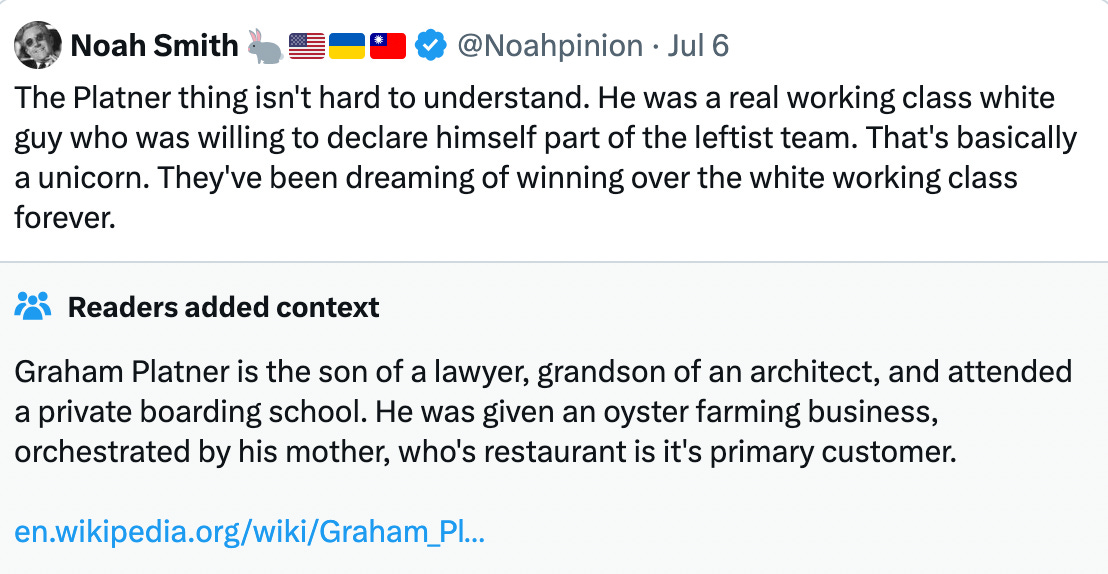
Graham Platner got to serve as a stand-in for all that is real and scrappy and self-made—got to be someone whose opponents could be cast as fancy boys and girls—not because this accurately describes his family history** but because self-mythologizing has always been an option. An option not equally open to all.
Paradoxically, his being straight, white, cisgender, male, non-Jewish, and preppy all somehow make it easier for him to claim scrappiness. It doesn’t make sense, but The Marginalized became NYT Lifestyle coverage of the 2010s-coded (a newspaper section that gave the mistaken impression that most genderfluid BIPOCs had their own fashion lines), and then earlier 2020s there was the thing where the hotness was stealth wealth and memes about how the Queen wasn’t in head-to-toe designer but rather dressed for mud-and-corgis so what was your excuse. Or, to not get out over the skis I don’t own, maybe it’s just that if the idea was for him to appeal to the white male working class, it helped that he is white, male, and working-class-passing.
So there is nothing remotely new or Trump-era-specific about a Platner cosplaying as Mr. Genuine Article. I’m sure if he and I met (not something I’d angle for), he’d look at me like the anthropomorphized kale leaf that I am.

*I am no great fan of its title or the punctuation and had wanted it to be called Your Privilege Is Showing but what’s past is past.
**The number of times I’ve heard ‘Stuyvesant isn’t a real public school’ well fine but it’s not Hotchkiss either; the non-boarding private school I went to prior to high school is more in that realm but I’m not the one calling myself working class in interviews and running as a beer-companion populist politician!!
“It was about haves versus have-nots, real people versus fake-and-fancy ones, and the jockeying for position among people who want everyone to know that if it’s going well for them it’s that they earned it and if it’s not it was the system whodunit.”
An astute and important argument and a really good book. Deserved more appreciation! But the incentives were otherwise.