Math problems

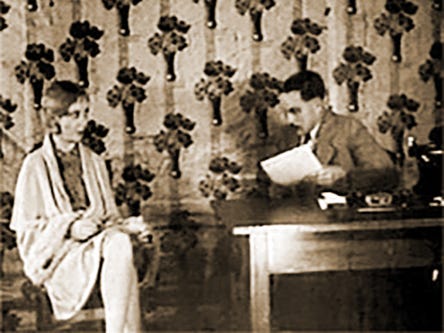

Larry Summers met a woman who was good at math. This was, perhaps, his downfall. A more appropriate Achilles’ heel has yet to be recorded.
Harvard’s semi-disgraced former president, still a top Harvard professor because academia is confusing like that, seems unlikely to go down in history as one of #MeToo’s true monsters, at least going by the Harvard Crimson exposé. (I’m well aware there’s more documentation out there but am not a completist.) But it is a bad look and then some to have extensively sexually pursued a young woman, a student at Harvard but not his student, whom you were mentoring.* It bodes that much less well, and yeah may slip into more monstrous territory, is that the man Summers saw fit to coach him through his women problems was Jeffrey Epstein. And not Jeffrey Epstein of enough decades ago that who could have known. This was up until Epstein’s 2019 arrest.
There are separate questions here: Is it always monstrous for people in different rungs of academia to have or aspire to relations? No. Is it ever OK to be a powerful older man and claim you’re mentoring a woman but actually be trying to get into her pants? No. Is it pedophilia-adjacent for a grown man in a position of professional or academic authority over a grown woman to get a crush? No. Is it wise or even ethical to take wooing advice from a man whose name is rightly synonymous with sex-pesting? No once again.
Point being, there are people who think it’s wrong whenever a relationship forms offline or with any power imbalance or or or. I am not among them, and it’s probably generational.
But this, if the story is accurate, it’s not good, and not just according to neo-rules of romantic etiquette. To form crushes on people who don’t like you back, or who you couldn’t hit on, is an unremarkable part of the human experience. To consult Jeffrey Epstein about how to realize such a crush, this, this is something special.
Let me put this another way: I’m someone who didn’t think he should be cancelled for the math comments and who’s not losing sleep over age gap relationships and I found this positively chilling: “This semester, he is teaching two large undergraduate courses and one graduate class.” It’s not that I lack the knowledge of academia to get how this came to pass, so no need to explain the concepts of tenure and A-list academics in the comments. It’s that what a world that it did.
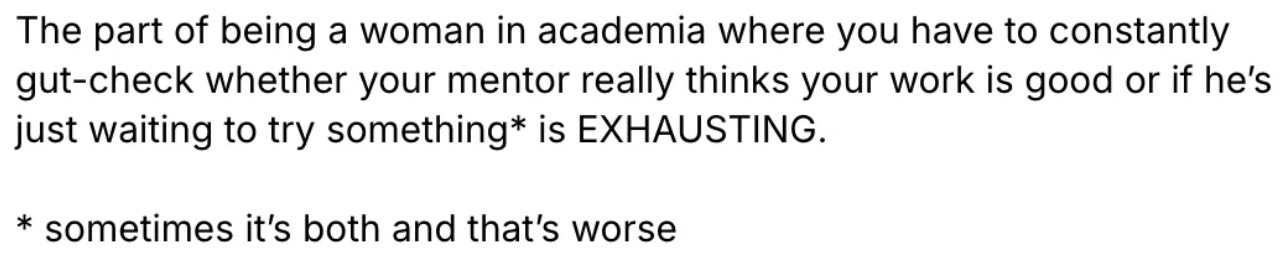
There is now, as I suppose there was bound to be, a discussion of how it goes for young women in higher ed. What if it’s not that women don’t shape-rotate as well as men, but rather that their male math professors’ eyes pop out of their heads when they see women?
A representative Bluesky post:
A lot of #MeToo involved this pretense of a monolithic female experience. Every woman you know experiences this. And then there’d be the inconvenient fact of women existing who did not experience this. Every woman on the internet has an inbox full of obscene DMs from strange men. Then there’d be the women for whom that is not a regular occurrence. And, confusingly, some of these women would be quite presentable, some a whole lot better-looking than I am.
As a young woman, I did fine if I may say so on the same-age-boyfriend-finding front. But I was never one who attracted the attention of powerful older men. This may have had something to do with my complete lack of interest in powerful older men. It’s not that they weren’t around. Maybe not mega-powerful ones ala Harvey Weinstein but big-name professors or editors or what have you. But they always seemed like blowhards, full of themselves, and simply less physically attractive than younger men, to me, when young myself. Liking them also felt like a grown-up version of sucking up to teachers, something that had always been against my nature. So I projected a distinct not interested. But I’m sure, had I been stunning, they’d have overlooked this. Like most women, like most people, I was to some tastes and not others. This is doubtless still true at 42, but I will be to fewer tastes because old, and it’s less relevant because married.
But when I think about my career and what it’s been, how do I assess? Was I spared the grief of having influential men pretend to like my writing when they really liked me? (Some men did do this, I’m now remembering, but never ones with any sort of power over my career. Just same-age guys.) Or would I have gotten ahead (and perhaps peaked) much earlier if big-wigs reacted to me with lust?
Should I feel grateful for never having had the specific experience of a famous or important man offering to help me professionally in exchange for dot dot dot? Or should I mope about what could have been, for me, if, at my most decorative, I’d been more so? #MeToo says I should feel relieved. Pretty-privilege theory says otherwise.
I’m thinking of that memorable essay by William Deresiewicz about how it supposedly goes for non-hideous young women. It’s a kind of bizarro version of #MeToo, according to which being a woman who makes the cut is pure privilege. It’s the same story of men chasing skirts, but in this telling, the skirts are in charge. There’s a lot about the piece that did not add up, most obviously (to me, and to other observers at the time) that only extremely beautiful women have the experiences he claims. But also, being the hotness is a mixed bag. Yes, it’s visibility, and yes, there are instances of women parlaying youthful beauty into longer-term successes. If you take a really expansive view of this then every woman who marries prior to middle age and remains happily coupled has maybe done this, but by the same token so has every man who’s done the same. But… #MeToo stuff. That, and the shelf life of hotness.
The best analysis of this damned-if-you-are, damned-if-you-aren’t phenomenon remains Marie Le Conte’s 2017 Medium post about “how [abusers] treat the women they don’t seek to abuse. In so many cases, men who sexually harass women struggle to register the existence of those other women, the useless ones.” She describes the dual modes, hit on and ignored, and how they’re part of the same system. She, as is I suspect true of most women, has been in both situations at different times, sometimes from the same men based on her own self-presentation. Here’s how she describes a workplace she had, in her 20s, with a creep for a boss:
He didn’t just continue groping those young women; he also kept on ignoring the ones he didn’t. The relief of not being one of his targets was bittersweet, as it meant that he would pay no attention to us at work, even ignoring us as he walked past our desk and we said hi.
Pretty privilege, ugly privilege, are these even the conversation to have here? The underlying issue in both cases is that it’s on the whole bad for women to be judged on the basis of sex appeal in arenas where this is irrelevant. And that’s most of them. If you stand to make a gazillion dollars as a supermodel (not that most do, even most fashion models), so be it, but why is it otherwise coming up? Plain women don’t want this, gorgeous ones certainly don’t (see: #MeToo), and the many many women who fall somewhere in between, we’re not so keen either.
***
Men, I’ve noticed, seem way more interested in the Epstein story than women are. This does not surprise me, and I’m trying to figure out why. Some could be the anxious squirming of the secretly guilty, but I don’t think that’s most of it.
Men think they’re being allies when they write about how aware they are that ALL women are subjected to. There’s something about this that unnerves me in the aggregate. Is it that it’s yet another case where men only see the women who register (to them, or to society generally) as desirable? Because I do think that’s part of it. They’re reciting the line about every woman having these experiences, because the women who don’t have them, they are not talking to in the first place.
Is it that one sometimes gets the impression that men (not all men and not only men! but, mainly men) find stories of older men violating young women and girls titillating? Because they do. They do! This is part of why #MeToo became a mainstream media obsession, and any number of feminist causes did not.
So yes, a thought for all the women leched upon by their supposed mentors. And one as well for those never mentored in the first place.
*It has taken all my restraint not to mention this, the only thing I can usually think of when anyone says “mentor.”
Are the men horrified, or are they sounding out whether they can get away with it themselves?
How much of the male reaction is related to diet mentality? "I had to turn down the ice cream, so you should have to turn down the ice cream; if you had the ice cream and didn't get fat (hit on the 16yo and didn't get caught/punished), I'm going to be big mad."
My only moment of glory was getting hit on by Bernard Williams at a philosophy colloquium in the 1980s. I know no one outside of philosophy has ever heard of Williams. But he was a big deal in philosophy! He was married at the time. I kind of cringe a bit whenever Kate Manne writes about how awesome Williams is, though if you like his philosophy that's totally fine. It's independent of his behavior at conferences. Manne's young, she's your age, so she probably never met him.
> Men, I’ve noticed, seem way more interested in the Epstein story than women are. This does not surprise me, and I’m trying to figure out why.
Most sexual violence is perpetrated by boring normal guys, but most guys *are* boring normal guys, and most of their friends are boring normal guys. The release valve for that cognitive dissonance is to focus on fantastical sex crimes that boring normal guys couldn't possibly pull off, as opposed to boring normal domestic abuse, which boring normal guys can and do pull off all the time. (This is also why a particular type of Substack commenter is weirdly fixated on sex crimes committed by trans women -- all two of them -- to say nothing of stuff like QAnon.)